

Personal Grief & Climate Grief
Listener at the Heart of Climate Grief
Personal Grief
Hold Fast: Navigating Personal and Climate Grief
Hold Fast: Navigating Personal and Climate Grief with a Reconciled Heart (2026) gathers the practices and insights that helped me live with traumatic bereavement and ongoing connection with my husband, now reframed for readers who may be experiencing many kinds of loss. The four core themes (or Stopping Places): acceptance, gratitude, forgiveness, and engagement, form the framework of the book.
Climate Grief
Creeksong: One Woman Sings the Climate Blues, A Memoir
Climate breakdown, eco-anxiety, and deep despair are now part of many people's daily reality, and both of my books arise from this shared crisis. Creeksong: One Woman Sings the Climate Blues, A Memoir (2023, 2026) follows the story and emotional journey of one woman learning to live with climate grief, inviting readers into the raw, personal experience of loving damaged places and species.
Hold Fast: Navigating Personal and Climate Grief
Hold Fast: Navigating Personal and Climate Grief with a Reconciled Heart (forthcoming, 2026) offers more explicit practices, frameworks, and guidance for navigating both personal and climate grief, supporting readers to stay present, grounded, and engaged even as the losses mount.
Opening to Climate Grief: A Workbook Companion to Hold Fast
Opening to Climate Grief: A Workbook Companion to Hold Fast (2026) is a letter-sized format book of 140 pages, designed to help readers work through their issues related to climate grief in a compassionate and grounded way, using drawing, journaling, and doodling.
The Seven Drawings
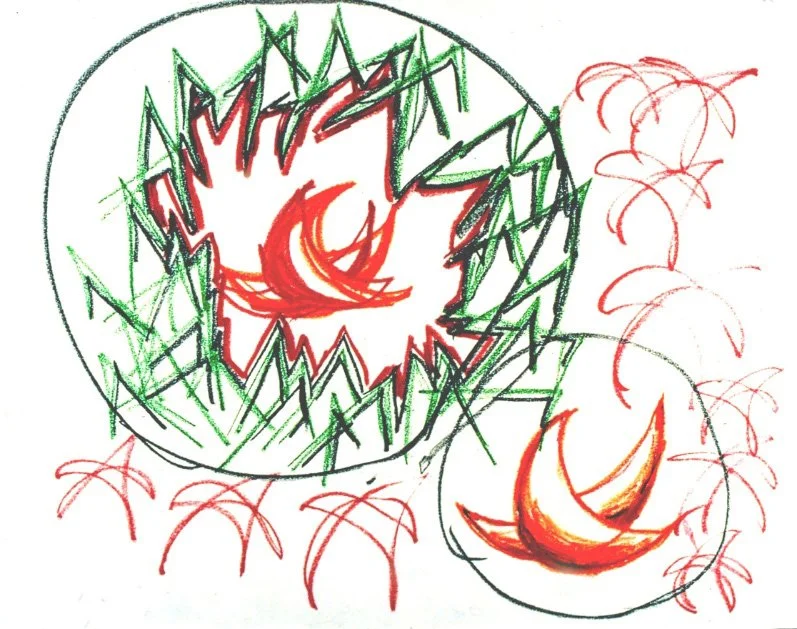
Image 1: Separation
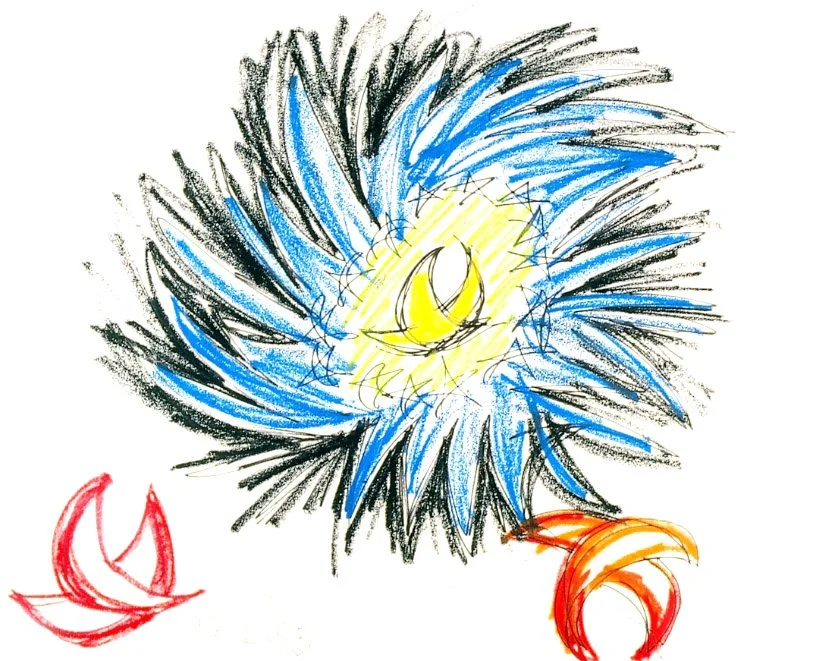
Image 2: Communication Breakdown
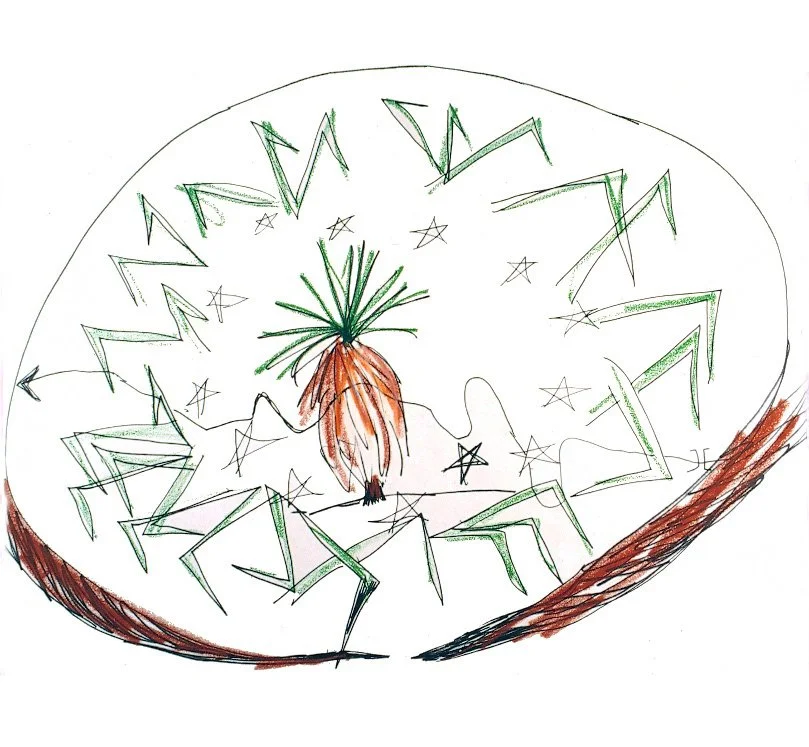
Image 3: Ungrounded
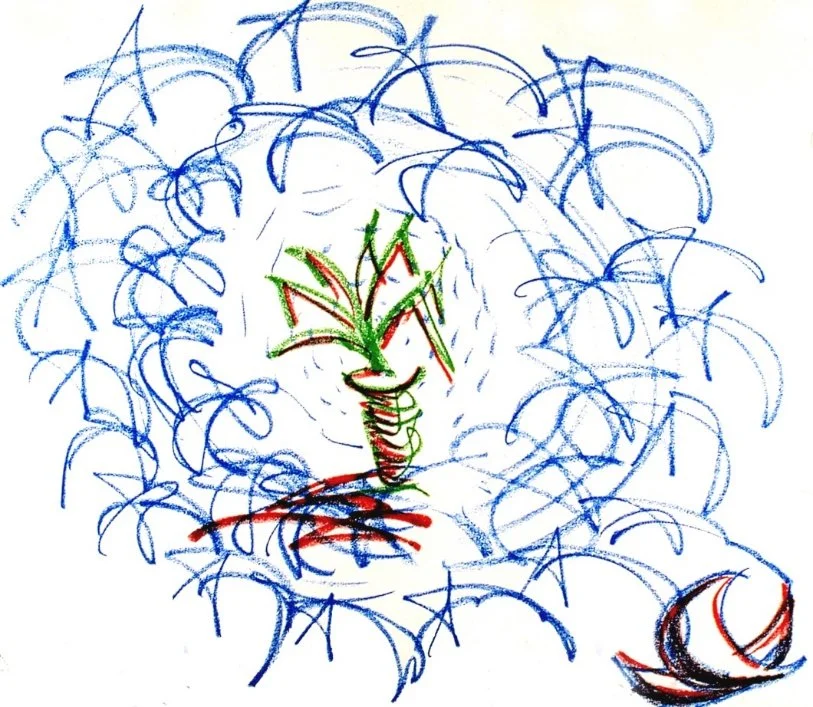
Image 4: Hopelessness
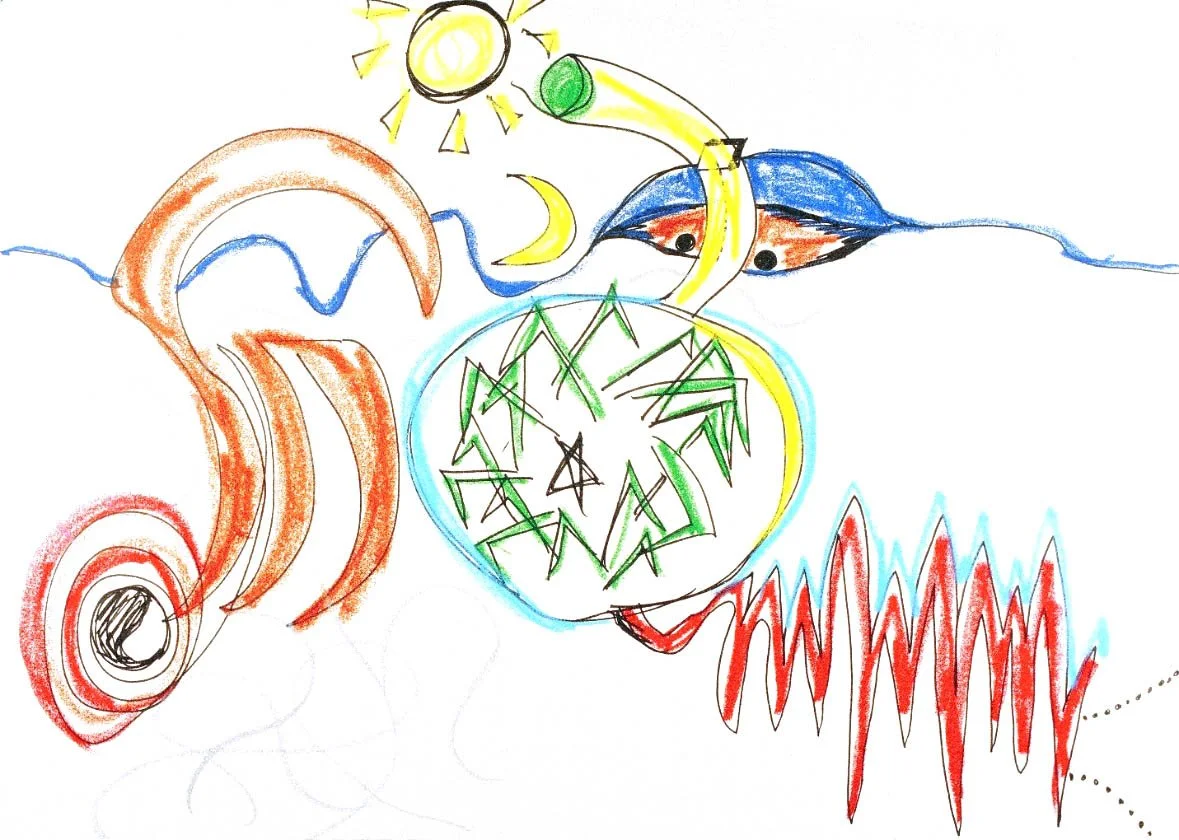
Image 5: Turbulence
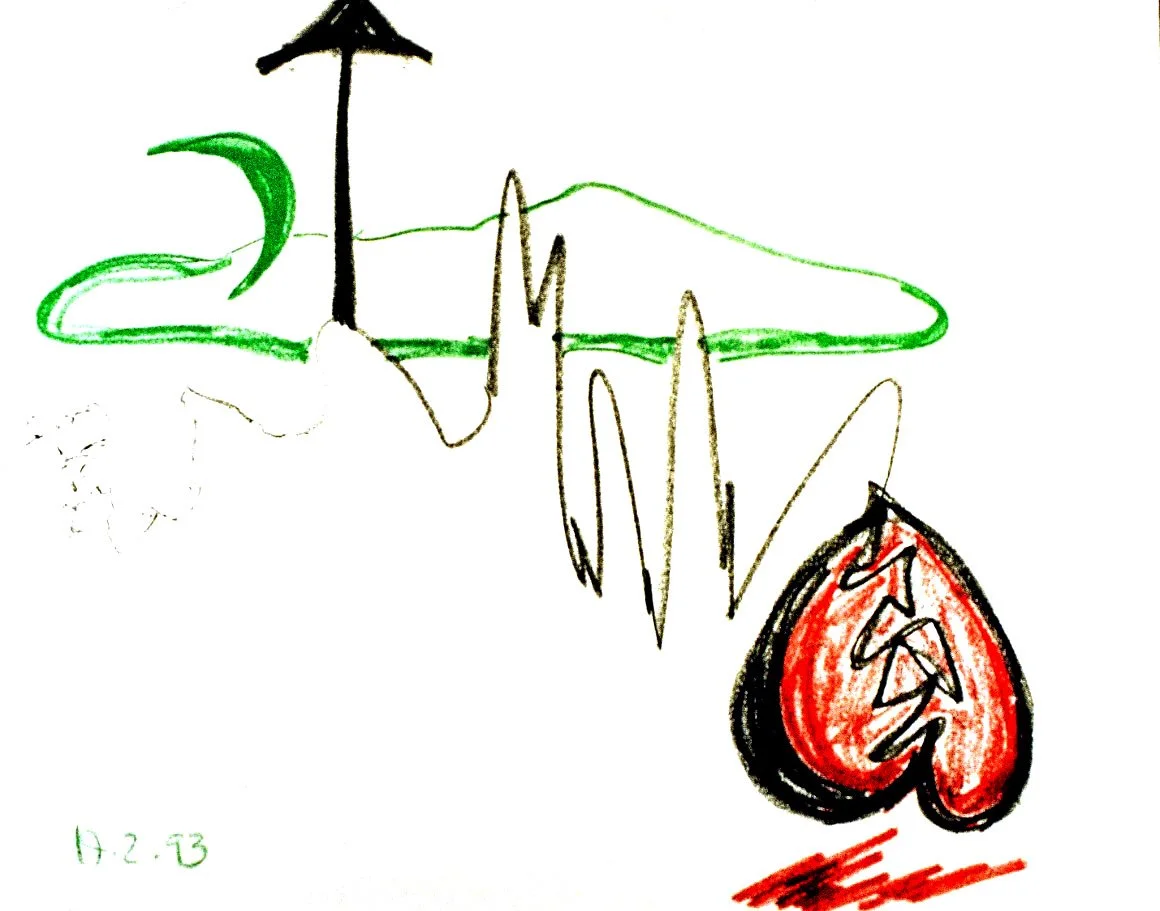
Image 6: Mending
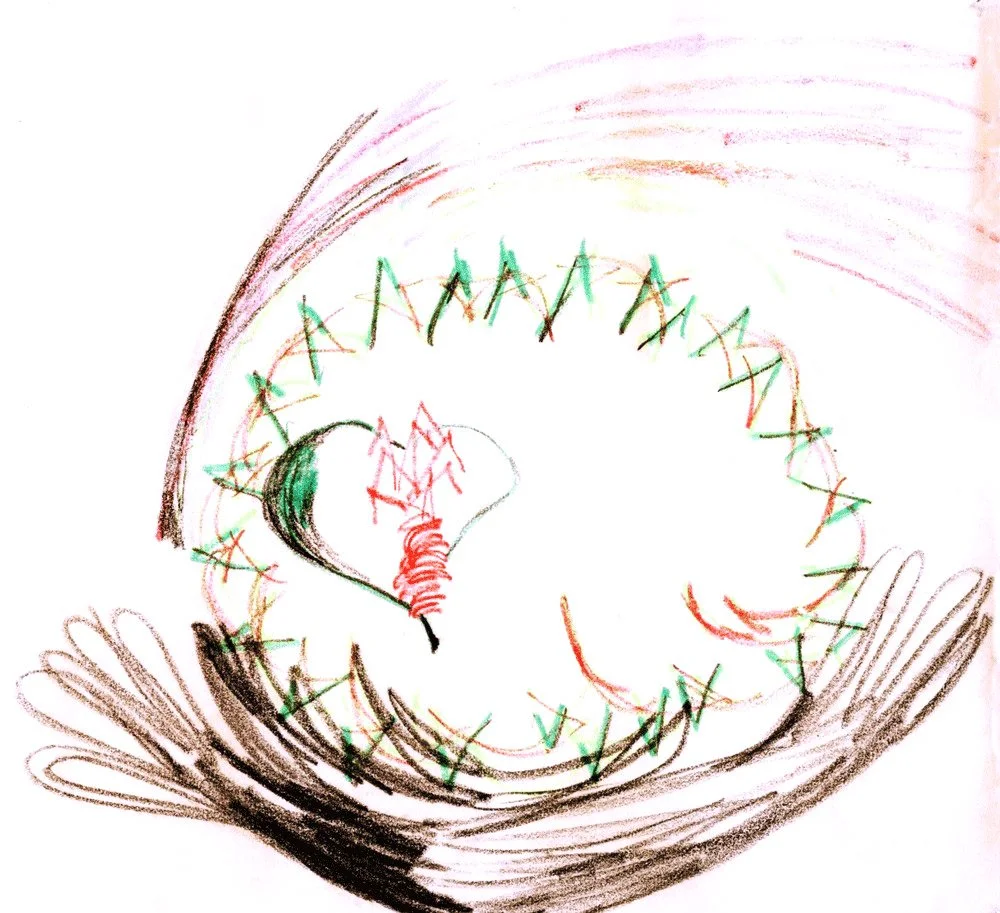
Image 7: Reciprocity
In 1993, newly arrived in Perth after a year alone in the tropical bush, I filled a large pad of paper with seven drawings in bright, thick colored pens. I had never been an artist.
I did not know why I was drawing, and I did not look at them again for twenty-eight years.
In 2021, in Vancouver, 28 years later, I finally sat down with an art therapist and let the drawings speak.
What emerged was a warning I had given myself three decades earlier, in a language I hadn't yet learned to read: that the grief I carried for the Earth and the grief I would come to carry for the people I love were never two separate sorrows.
They were one.
Then, astonishingly, I lost them again. Not the meaning, that I kept.
And the drawings themselves went back into storage and stayed there for five more years, through everything that became Hold Fast, until they resurfaced, unbidden, in the very last week of writing this book.
I don't fully understand what that says about denial, or readiness, or the strange timing of the things we most need to see.
What I know is that they arrived exactly when the book was finally ready to hold them.
The Seven Drawings
My rediscovery of the seven drawings occurred in 2021, when I was beginning to write the first book in this Trilogy: Creeksong: One Woman Sings the Climate Blues (2023, 2026). Their dramatic appearance reminded me that, despite the reversal of my fortunes caused by Karl’s death and my injuries, I had promised the Earth Mother and was consecrated in Her service.
And the global ecological situation had hardly improved.
The Earth urgently needed my help.
I want to tell you something I did not understand myself until very recently. Karl was not the first time I tried to hold fast to something I was losing. Long before I had those words, long before I had any of the words in this book, I had already tried, once, without knowing I was trying. I had just turned fifty. I did not know I was leaving a record. I did not know I would not be able to read it for twenty-eight years.
It is a rainy summer afternoon, Friday, February 19th, 1993. I have been at my new university, Murdoch, in Perth, Western Australia, for seven weeks, and I am slowly beginning to understand life as a doctoral student there.
I do not know that I will need a full year to make sense of my year at Deep Creek. Some lessons will take decades to learn.
This Friday, I have nowhere to go. Most of the other students have left. I am alone in the Institute for Sustainability and Technology Policy. I find a large box of colored pens and a pad of unlined paper, and soon I am drawing.
Seven drawings flow from me.
After I draw them, I completely ignore these drawings for twenty-eight years. Then, in early 2021, I look at them again. I seek help from an art therapist to interpret them. And I uncover seven desperate messages from our dying Earth.
Drawing 1: Separation
A newly formed, glowing being sits inside a full, unbroken circle of sharp pandanus fronds, doubled, with a second version of itself living just outside that protection. Three sets of five-pointed stars, in threes, ring the whole image. The being’s own presence casts a shape at its center like a maple leaf.
In Separation, the first drawing, I hear the Earth begging for help: “Oh, Wendy, you are connected to the forest’s magic and sacredness. You will never lose that connection. There you learned new ways of feeling, believing, and understanding.
Now you must go forward to finish the work you began. Our connection will sustain you. There is no time to waste.”
Drawing 2: Communication Breakdown
The same central being glows within a much more open, permeable ring of fronds. Now its two outer echoes have drifted apart from each other, no longer sharing a circle of their own. The stars scatter, rather than gathering in threes.
The drawing is fiercely dynamic, full of light but shrieking a warning about communication breakdown: “During your time in the forest, you received a clear message. But you still cannot communicate it. You feel weak, adrift, even upside down, and distant from the forest’s magic. But you are never separate from the source. You must communicate the forest’s lessons, Wendy. The matter is urgent. Others urgently need to hear your message.”
Drawing 3: Ungrounded
The figures have disappeared. The Earth Mother stands grounded by a visible dark root in the black earth of my creek, under a star-spangled sky, ringed by permeable fronds and a further circle of stars. But the ground beneath her has broken open. It’s reachable only by burrowing through the earth, and only from the south.
The Earth Mother, who consecrated me at Deep Creek, is the central figure in Ungrounded, the third drawing. She cries: “You find yourself in hostile territory, lacking a firm foundation, Wendy. These lonely feelings of nervousness and confusion are not yours alone. Your Deep Creek sojourn sensitized you to the Earth’s pain and the danger that now terrifies all beings. Your huge vulnerability comes from your ungrounded magic. Don’t imagine that any of us are on firm ground, girl.”
“Wendy: you can communicate our message by singing your creek’s song. Try to be fluid in your communication and accept your worthiness to speak on our behalf. You must find a way to reweave the fabric of the Earth. We gave you those skills. Now use them for the weaving you must do.”
Drawing 4: Hopelessness
A single pandanus palm stands alone now, casting a brilliant red shadow inside a soft, permeable field where the sharp fronds and stars have merged into gentler shapes. For the first time, the small two-part being outside the circle is neither red nor orange, but blue, tethered to the boundary by a thin strand.
The message of the fourth drawing brings me to tears: “I am the representation of hopelessness. Now you must face the Earth’s hopelessness, Wendy. We are losing our vitality and our tenuous connections are weakening. For the first time, the Earth is perched on the edge. Our human energy no longer has the ability to ground us. All of Earth’s beings feel fragile, powerless, and hopeless now. If you cannot regain your power, this huge malaise will seep into you, and you will lose your connection with us.”
“You are asking the wrong questions, Wendy. Don’t ask, ‘Am I green enough to save the Earth?’ Ask what you can do.
There is only so much a Mother can do!
Help us in your weakness, please, Wendy, we beg you! Do something! You are only one person, true. And you are a human, and the Earth is dying.”
Drawing 5: Turbulence
The creek splits the page, its waters seeming to carry eyes and sight. A sun and a yellow crescent moon hang where the house once stood, and a ragged line traces the long, indirect journey south to Perth. Turbulence is the most crowded of the seven drawings.
I stare at the fifth drawing. How could I have drawn this! And I hear the voice: “You are alone with your magic. Gaia is no longer present in your life. Nobody is listening to you. You have retreated from the crises that surround you. There is only one way out: remember your creek. It is the sacred realm of the Mother.
It is critical that you immerse yourself, metaphorically, in your creek. And it will feed you.”
“You have strong intuition and well-developed mental faculties, Wendy. But the forces disrupting the Earth’s systems have blinded you. All of us are losing hope in this turbulent environment. We must trust you. You must get your voice back and go forward as a determined being to make a difference.”
Shaking, I hold my head in my hands.
The tables have turned.
In 1991, I sought refuge and solace. I begged the Earth to heal me. And She did.
Now it’s my turn to repay Her gifts. Regardless of my weakness and lack of confidence, I must venture forward in the service of the Earth.
I gently pick up the sixth drawing.
All is not well here, either. I stare in horror.
Drawing 6: Mending
The creek narrows and rises into a suspended, upside-down human heart, reached by a jagged, cardiogram-like path and casting its own red shadow. A black arrow rises from a small island below, and the broken heart appears to be knitting itself back together, like a puzzle. No pandanus palm appears anywhere in this drawing.
This drawing is called Mending. To my horror, my beloved creek now flows backwards.
The Mother speaks again: “Wendy, your creek is flowing backwards! That signals that the natural order of things on Earth is reversing. Death is everywhere, especially in the Southern Hemisphere. Destructive forces are wreaking havoc. Your scorched and broken heart is hanging upside down.”
“The grief you experience for the Earth has dispirited you. And you will find a new source of hope and healing. The moon will nourish your ‘green’ understanding, and you can depend on your new intuition and insights. You must tell your story and explain the lessons the forest taught you. Always, always, return to your creek. It will carry you forward to a refuge on a sacred mountain.”
This is my turning point. So much is lost, never to return. And my creek’s song will guide me. I will make a difference for the Earth.
I reach for my final drawing.
Drawing 7: Reciprocity
My own heart, held inside a circle of pandanus fronds fused with red and black stars, rests in the open hands of the black Earth. Inside the heart, small and glowing, grows a pandanus palm, the Earth Mother herself, alive and accessible from below.
I name this drawing Reciprocity. Everything about it makes my heart sing.
I hear a gentle, reassuring voice:
“Oh, Wendy, sojourner and traveler, truth-seeker, and occasional lost soul, your forest journey will bring a healing conclusion. See the hands of the black Earth holding your green, wounded heart. Inside your heart lives the Mother. You know Her as the pandanus tree so sacred to you. She begs your protection and offers protection in return. Wild Nature encircles and protects you as she welcomes you back.”
“Yours has been a long journey, Wendy, and now you are an old woman. Your forest sojourn rewarded you and radicalized your thinking. Now you can see the ‘reciprocal way’ of your connection with Nature. Now is the time to accept your birthright, Wendy. Weave your personal myth into our story and bring it full circle. There is no time but the present for this work. Full circle.”
“Before you went to live in the forest, you forgot what was natural and did not know what you had forgotten. Now you must remind humans that it is natural to love the Earth. The situation is so desperate now that we’re depending on prayers. Pray for us, Wendy, as we pray for you.”
In 1993, when I made this drawing, I did not have words for what I drew. And the warning was already there, waiting, in seven drawings I would not let myself read for twenty-eight years.
When I look at all seven drawings together, the picture is unmistakable: a shelter that stood whole at the start thins, cracks, and empties like a creek bed in drought, until by the sixth drawing a heart hangs upside down, bare to the weather, with nothing left standing between it and the sky. And then, astonishingly, in the seventh, that same exposed heart is caught, gathered into the cupped hands of the Earth Mother herself, the very ground it had spent six drawings drifting away from, the way a river finally reaches the sea it was always running toward.
To sit with them in 2021 was to feel first the cold shock of recognition, that a warning this plain could lie folded in a drawer for twenty-eight years while the thing it warned of went on unfolding outside my window, season after season, unheeded. And beneath the shock, a grief almost too tender to name, grief for the young woman who drew her own rescue in bright colors and did not yet have the ears to hear her own hand, the way a seed can carry a whole forest inside it and still wait decades in the dark for the one season wet enough to let it break open.
And so the lesson, when it finally arrived, arrived less as comfort than as reckoning: reciprocity is not a grace I am owed but a debt I already signed for, in bright colors, in 1993, without knowing it, root and current binding me to the Earth Mother as surely as she once bound herself to me.
What she asked of me then, she is still asking now, in the same quiet, patient voice of water finding its way back to itself, and this time, before the drought outlasts the memory of rain, I mean to answer.
Here is where Part Two of this book begins.
Here, with a heavy heart, we turn away from personal grief and begin to navigate the territory of our greater, shared sorrow.