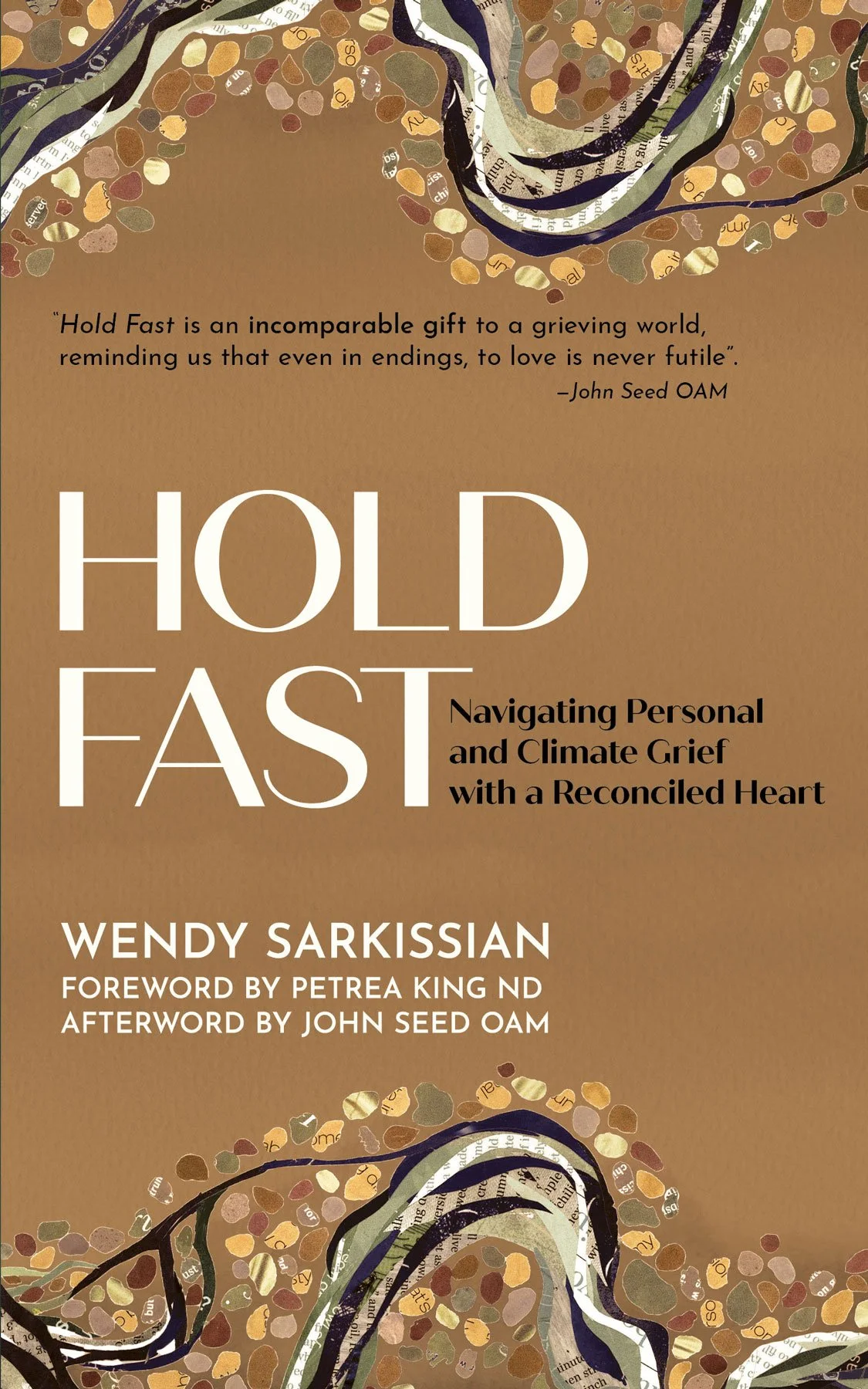
Hold Fast: Navigating Personal and Climate Grief with a Reconciled Heart
This new book (2026) explores how the practices that helped me live with traumatic bereavement can also support other grieving people and guide us as we face climate collapse.
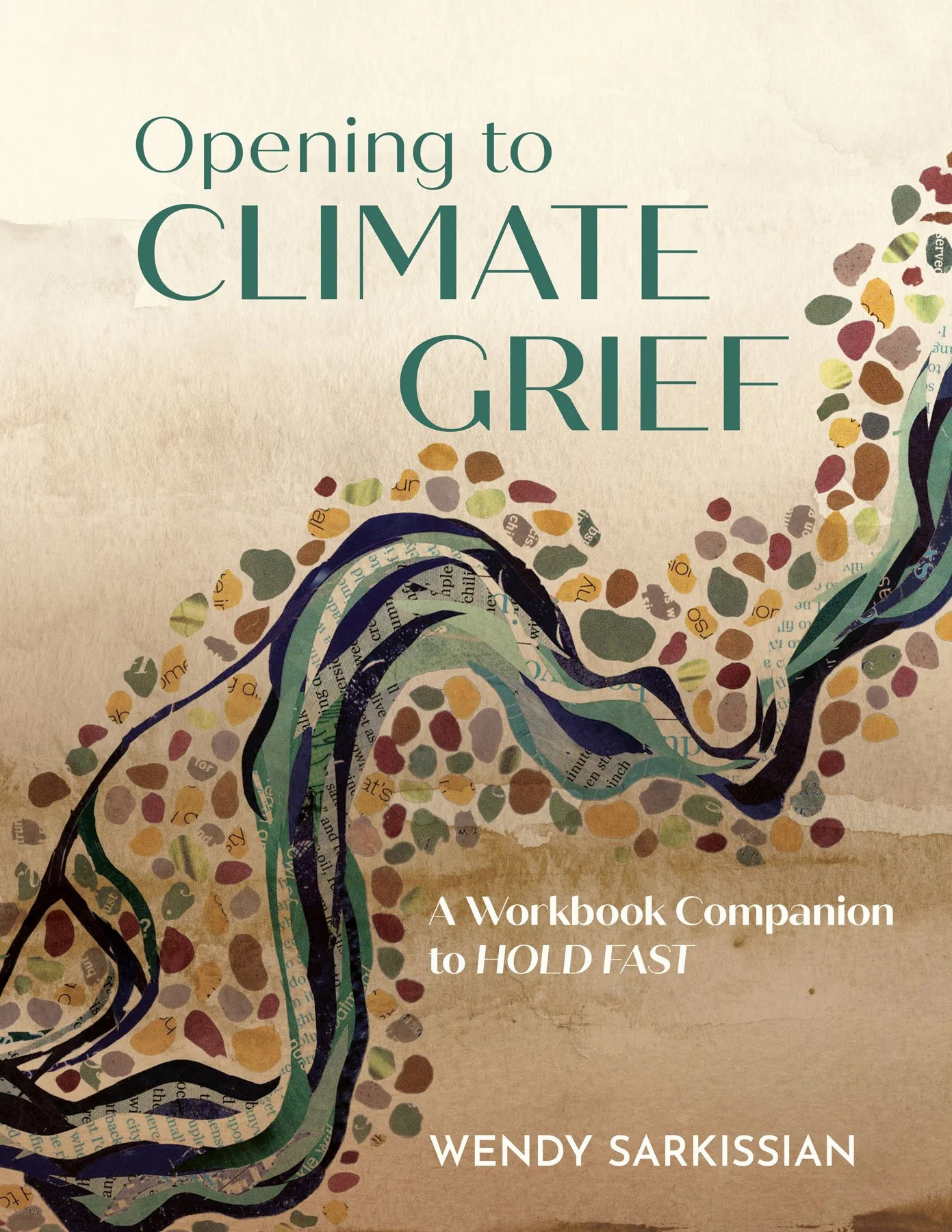
Looking for the companion workbook? Opening to Climate Grief puts these ideas into practice.
Hold Fast: Navigating Personal and Climate Grief with a Reconciled Heart
Hold Fast is a book in two parts, built around four practices: Acceptance, Gratitude, Forgiveness, Service to Others. Part One follows Wendy Sarkissian through her husband Karl's death, and the four practices she built, one deliberate step at a time, to survive it. Part Two follows her back into those same four practices years later, facing a different loss: forests, rivers, and a climate collapsing around her. What emerges from both is the Reconciled Ecological Self, Sarkissian's original framework for staying connected to what we love as it changes, rather than retreating from the loss of it.
At the center of the book sits a mystery Sarkissian herself cannot fully explain. In 1993, she filled a large pad of paper with seven drawings in bright, thick colored pens, and then put them away. She would lose them not once but twice, first for twenty-eight years, then again for five more, resurfacing only in the last week this book was written. What she found in them, finally, was a warning she had given herself decades before she had words for it: proof that personal grief and planetary grief were never two separate sorrows, and a hard, honest look at why even someone who never doubted the truth of that warning could still bury it, twice, rather than carry it.
Wendy Sarkissian's original concept of The Reconciled Ecological Self is one of the most important psychological and ethical concepts to emerge in this century. Hold Fast is an incomparable gift to a grieving world. Perhaps it is even the Manual for Living with Defeat that Leonard Cohen would have written had his muse allowed.
John Seed
OAM, deep ecologist, founder of the Rainforest Information Centre, Australia
Hold Fast is a triumph of active acceptance over the toxicity of fear and debilitating despair in the face of both personal grief and planetary disintegration. It reveals a redemptive way of being while braving irreparable loss in a fractured world: a Reconciled Ecological Self. This compelling and courageous Self honestly acknowledges tragedy while simultaneously engaging in loving service to others, the "sacred work of sorrow." What a powerful, profound holding fast to connectedness and to love Wendy Sarkissian has gifted to all of us!"
Patsy Hallen
PhD, Associate Professor, Curtin University, Perth, Western Australia
Wendy Sarkissian was my doctoral student thirty years ago, when she first asked whether planners could be encouraged to truly care for Nature. In Hold Fast, she asks a harder question still: whether we can grieve, honestly and together, both the people and the Earth we have lost. As someone who has spent a career showing how our cities themselves drive climate breakdown and have huge potential to regenerate our climate and our environment, I recognize in this book a necessary companion: one that recognizes the importance of climate grief yet never abandons hope."
Peter Newman
AO, John Curtin Distinguished Professor, Curtin University Sustainability Policy Institute, Perth, Western Australia; Lead Author for Transport, Intergovernmental Panel on Climate Change (IPCC)
Image to come
Extract: A Legend for Our Times
As I was writing this book, a voice reminded me of my Scottish heritage. (Having an Armenian name, it's easy to be "Armenian." But I have lots of Scots in me as well.)
"Hold Fast" is the motto of the MacLeod clan of the Isle of Skye. About 150 years ago, both of my father's maternal grandparents emigrated from Skye to Canada, bringing that island's resilience to the harsh Canadian prairies.
According to legend, the motto originates with Malcolm MacLeod, the third Chief (1296 to 1370). Far from his castle, he was once confronted by a wild bull. As he wrestled it, his clansmen cried, "Hold Fast, MacLeod!" He prevailed, and "Hold Fast" became both his name and the clan's motto.
The phrase, with its nautical overtones, has come to mean holding on to what matters in the face of danger.
It feels an apt title for a book about healing grief: we must hold fast to ourselves, to those we love (human and greater-than-human), and to the living Earth.
To do that, we may need to reach across the divide of death, as I did with my late husband, Karl, and across the widening divide between industrial society and the greater-than-human world. We must also hold fast to our conviction that all life is worthy of our consideration and care, despite the challenges we face.